
Cover art comparison
There are two known Antrop’s versions of the cover: one with the English title HELP! and another with the Cyrillic “ПОМОГИ” (“Help” in Russian). The image was mirrored, and the band members’ heads were taken from the back cover of the American edition.

Artist Yuri Trifonov recalls, “We had the idea to replace them with the heads from a poster where they’re standing by the sea — the one with John in a straw hat. I can’t even remember if we ever followed through with it or not.”
What the Beatles really show on Help!
The resulting image on the English version of the album did not spell “HELP” but rather “NUJV”. Interestingly, for the American version released by Capitol, both the cover and the arrangement were altered to “NVUJ”.
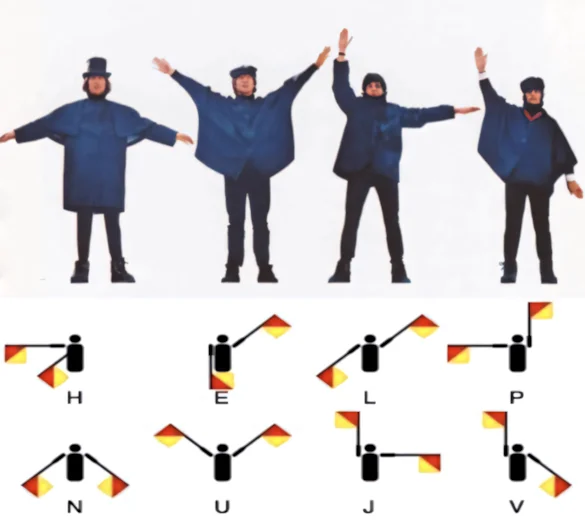
Designer Nikolai Kibalchich tried to fix what he saw as a mistake from the original Parlophone release: “We simply corrected the error they made. On our cover, the guys are arranged in the proper order to spell out the word ‘HELP!’ in semaphore.” In reality, though, the configuration still didn’t form the word HELP — instead, Kibalchich’s arrangement spelled out the code LPUN.
Second version

As for the typography, Trifonov recalls, “There was this guy — a computer genius, probably — who worked with fonts. He did everything by hand, just creating like that.”
Back sleeve
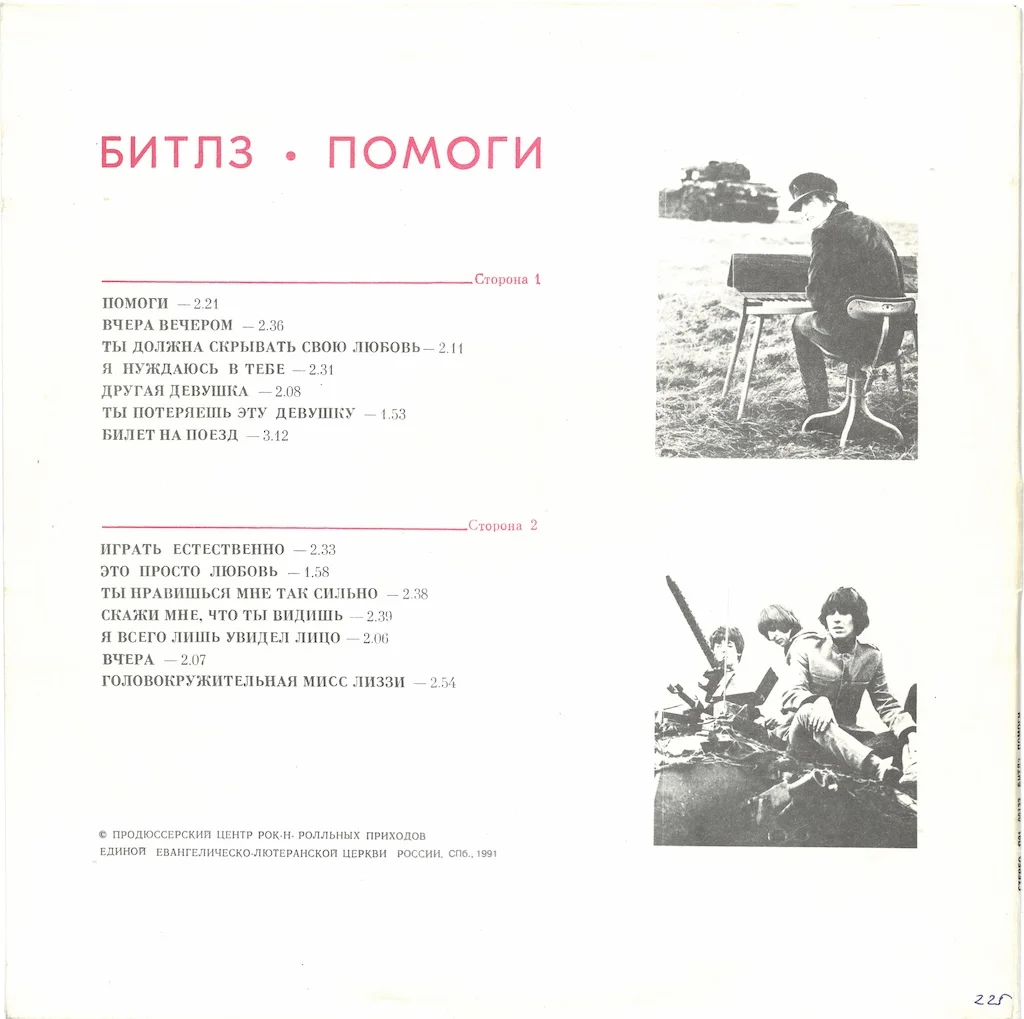
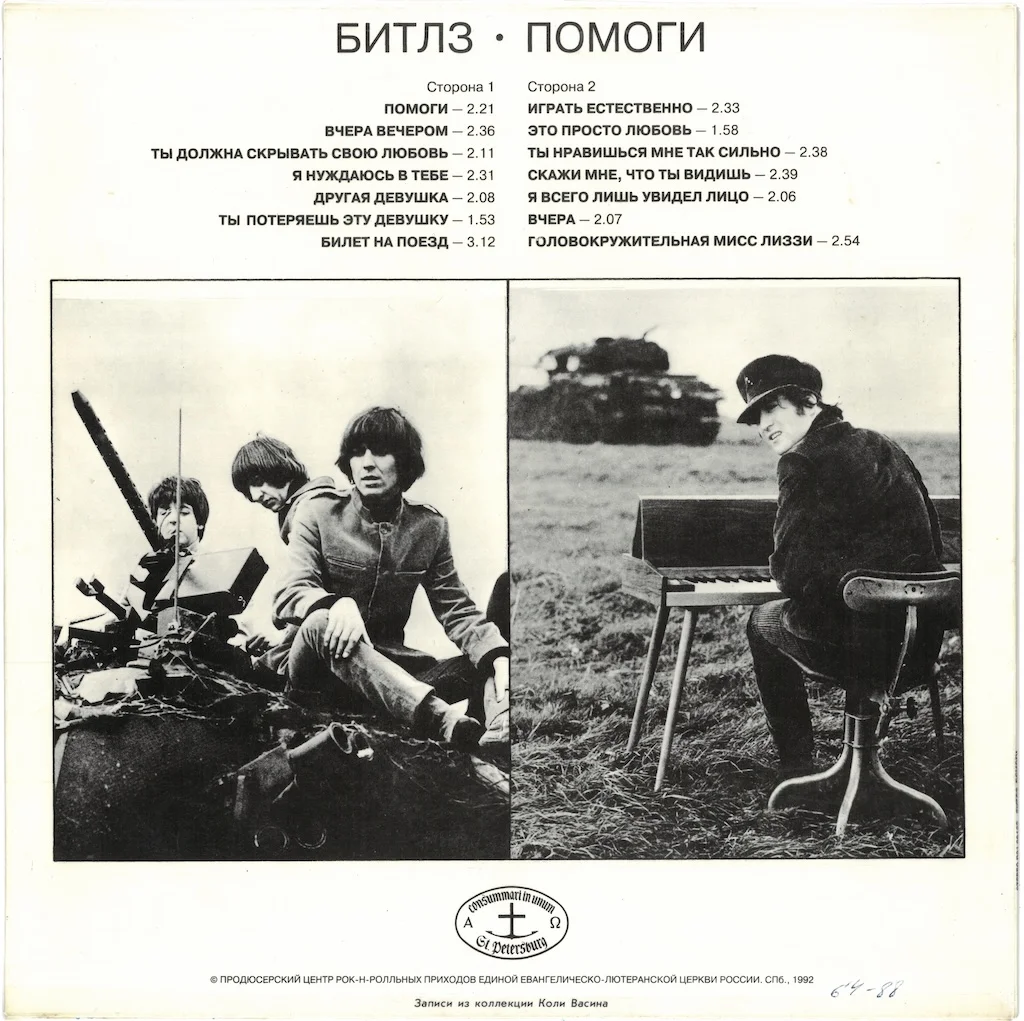
There are two different Antrop variations of the cover, each with different print quality and typos in the liner text. One is the non-laminated version with the translated title on the back, and the other is a laminated edition with the English title, where the photo quality is noticeably better.
The first part of record’s run was released with the defect: the running time of Ты потеряешь эту девушку (You’re Going To Lose That Girl) is 1:50 instead of authorized 2:16, because the first part of the song sounds as being played faster (similar to sound effect appears while CD-player being used in search mode). This defect says the phonogram from CD was used for manufacturing the vinyl records.
Inner sleeve
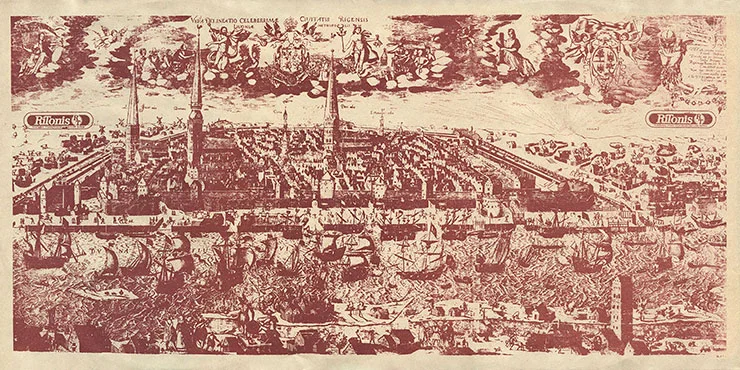
You can find album copies where the LP is inserted not into usual white paper or cellophane inner sleeve but into wrap-around inner picture sleeve. It’s a sheet of paper (with picture on outside only), folded up in half, with image of medieval Riga town and RITONIS logo – the name which Melodiya’s Riga Plant got approx. in 1990 [see Pic. 3]. “РиТонис” (RITONIS) is abbreviation of RIGA TONIS (in Latvian language) that roughly means “Riga tone” or “Riga sound”. Such album copies were manufactured in Latvia by the former Melodiya’s Riga Plant. These wrap-around inner sleeves can be of various colors.
Rare cover draft
Draft by Yuri Trifonov
Ringo Starr signs Russian bootleg
It is arguable that Ringo Starr saw and kept in hand one of Russian variations of LP HELP! by AnTrop. And even autographed it (in two months and three weeks after album release) – Pic. 19-21 show photographs, as the Internet says, taken at Time Takes Time album party which came off on May 27, 1992 in the USA.
Help in the USSR and Russia
In the Soviet Union, Yesterday was translated into russian and covered by Emil Horovets, while it’s original was often misheard and became a mondegreen meme.
© 2024 Artur Netsvetaev, interviews with Nikolai Kibalchich, Yuri Trifonov.
Images: beatlesvynil.com.ua, author’s archive
Leave a Reply
You must be logged in to post a comment.