
Things like homophonic translation, soramimi and Soviet mondegreens are very interesting. Especially Soviet mishearings of English songs. This article aims to tell the history and evolution of mishearings (mondegreens) in the Soviet Union as reflected in Beatles lyrics and titles, based on every documented source I could locate.
In the mid-1950s, foreign rock ‘n’ roll music started to reach the Soviet Union through illegal radio broadcasts. In Leningrad, you could usually pick up broadcasts from Finland, France, or Eastern Europe. Later, you could even pick up the BBC, even though the signals were often jammed and weak. But you could still hear and tape the BBC. At the same time, “bone records” (music cut onto used X-ray film) and the first official foreign vinyl records started to circulate.
Table of Content
- Official translations and Soviet adaptations of Beatles songs
- Russian Homophones or Something More?
- Beatles Mondegreens in the USSR (Soviet Russia)
- List of popular Beatles homophones in the USSR in the 1960s and 1970s
- Lyric Parodies Based on Homophones
- List of Non-Beatles USSR Homophones In The Late 70s & 80s
- Homophones Beyond Songs
- Why & How Homophones Appeared in the Soviet Union
- 1. The humor and wordplay of musicians and early translators
- 2. A semi-underground rock-culture
- 3. Moving beyond just covers
- 4. Accidental domestication by listeners — meme development by musicians
- Sources
Young musicians didn’t just listen to Little Richard, Chuck Berry, and the Beatles; they recorded the songs on reel-to-reel machines, tried to learn the chords, and wrote down the English lyrics by ear and often misinterpret lyrics. They would then practice with their bands and perform at schools or cafes. Up until the early 1970s, it was legal for Soviet “amateur” rock groups to perform in English.
Official translations and Soviet adaptations of Beatles songs
From the late 1960s onward, people started translating foreign songs into Russian. It was common to print song titles in Russian. For an official performance or a release on the state label Melodiya, a full Russian-language lyric was required.
Melodiya officially changed titles to Russian since 1950s. Alexei Yurchak in his research “Everything Was Forever, Until It Was No More: The Last Soviet Generation” (2005, p. 190) wrote about it:
This one “bourgeois” track was commonly renamed and its attribution changed, to make it appear more appropriate for the Soviet listeners. For example, in the 1950s, Melodiia renamed the U.S. jazz composition “American patrol” as “On Guard” (Na zastave) to avoid the word “American.”
The same applied to text translations.. These “translations” were equirhythmic but usually became loose adaptations with simpler, lighter arrangements. There were some times when they let bands play in English, like when Uriah Heep’s “Sunrise” and “July Morning,” and the Beatles’ “Something” were sung in English in the 70s. But most of the time, Soviet bands sang in Russian, and their versions were very different from the original songs.
A Few Soviet Covers Examples
Many musicians who performed Beatles covers on stage left the USSR in the 1970s.
There is nothing surprising about the adaptation of popular English-language songs in West Europe. For example, Ob-La-Di, Ob-La-Da was also covered with different lyrics in Bulgaria and Poland:
Beyond just making it more accessible to listeners—and projecting the officially approved “Soviet” character—these censored localizations made sure that the new Soviet lyricists got paid, while the original authors didn’t receive any royalties (in the USSR, until 1973, translations were treated as separate works, so the originals weren’t paid).
There was even a translation-adaptation of “Back to the USSR” printed in Rovesnik magazine and separately, in Songs for Radio and Cinema with sheet music in 1970. But as with “Drive My Car,” the original was pretty much gone, except for the chorus: no Miami, no Ukraine girls, or anything “suspicious.”

Here is a back translation of the 1970 Soviet version of Back in the USSR
Slowly diving down into the clouds
Our huge airplane
It’s taking me to Moscow from afar
Soon the flight will be over
Chorus: I’m back in the USSR!
I’m very happy, guys,
Back in the USSR!
I hardly recognize familiar places
The construction sites are astonishing to look at
I enter the hotel, a huge new house
Is everything all right? I’m so glad!
Chorus.
What you can see here
You can’t see anywhere else
There’s cities and mountains waiting for me
There’s not enough words to tell you
What eyes the girls have here!
Chorus.
I want to see the sunny Caucasus,
To Samarkand to continue my way.
I want to see Leningrad this time
And to look at Suzdal again!
Chorus.
Seems like Melodiya itself, with its tradition of translating, censoring, and adapting titles and lyrics, encouraged people to reproduce this habit. So, listeners of the original albums and unofficial English-language covers by the first Soviet beat groups often changed the titles and lyrics—keeping the sound-alike feel but adding a distinctly Soviet-USSR flavor and raw humor.
Russian Homophones or Something More?
I’ve only found a few mentions of this Soviet-English, cross-linguistic phenomenon in the English-speaking world. So I gathered all the data I could find in Russian to make this research and almost full list of Soviet homophones of The Beatles songs.
- I gathered every excerpt, anecdote, and mention I could locate — including folklore, fanzines, interviews, forum posts in english and russian — to assemble a provisional list of Soviet homophones of Beatles lyrics.
- I cross-checked each homophone with print archives, fan memoirs, and contemporary Soviet youth publications when possible.
- Given how rarely this phenomenon has been studied formally, this compilation offers a starting base for further researches.
The general idea of mondegreensworks within a single language (“a mishearing or misinterpretation of a phrase in a way that gives it a new meaning”), while the Japanese term soramimirefers to foreign language mishearings. I think the Soviet habit of changing English song titles is an example of cross-language homophones—words that sound alike but are spelled differently and can mean different things. The closest existing term is homophonic translation.
It’s not like regular cross-linguistic homophones (two words from different languages that sound the same but mean different things—basically, a false friend), where it seems like Soviet homophonic song titles picked up extra layers of meaning and satiric context that were obvious to natives. It’s tricky to explain the abstract associative link between some of these distorted titles and their originals or a Soviet life. Still, most titles are just absurd and funny, but they don’t really mean anything, similar to Internet memes. Confirmed examples appear in The Times and PRX; broader lists persist as oral folklore.
This probably started happening in the USSR even before rock ‘n’ roll came around: Glenn Miller’s 1941 “Chattanooga Choo Choo” was shortened to “ChuCha” (“Чуча”) in Russian. Then, in the 1950s, stilyagi (Soviet hipsters) picked it up. Phrases like “Byla b baba Dunya, ona b dala” (alt.: “baba Lyuba” — “If Lyuba were here, she would let me…”) circulated in different versions, mapped either onto Gene Vincent’s “Be-Bop-A-Lula” or Little Richard’s “Tutti-Frutti.”
At last, Soviet homophones caught on all over the place in the 1960s, along with the first records and tape-to-tape copies of English songs. A lot of listeners didn’t speak English, so they chose Russian words that sounded similar and fit the original meter instead of a precise translation. This was because the lyrics had been changed over and over again on the tape, and they weren’t as clear.
Beatles Mondegreens in the USSR (Soviet Russia)
The Beatles were most often subjected to “folk” adaptations, as the most popular foreign band. (By the way, on Melodiya’s first record featuring “Girl” in 1967, the label even credited “English folk tune, The Beatles quartet.”)
At the same time, in 60-s and 70s, “recording studios” appear in the Soviet Union — shops where you can “legally” record various songs on flexible discs, instead of buying x-rays:
For a long time, from the beginning of their existence, sound-recording studios were recording music onto transparent or one-color celluloid records. Sometimes – even onto X-ray film. Later, photographs covered with a celluloid layer began to be used.
In most cases (if not always), sound-recording studios didn’t indicate either the title of the song or the artist on cut records and postcards-records. The owners of these flexible records and postcards, if desired, signed them themselves. Some people knew what they ordered and purchased. Some had no clue – just liked the music. Therefore, such music lovers indicated by hand, by Cyrillic or Latin letters, the song(s) and artist(s) as they thought or as they heard. For this reason, you can find absolutely incredible titles, which sometimes don’t allow understanding at once what kind of music is recorded on the record or postcard-record.
List of popular Beatles homophones in the USSR in the 1960s and 1970s
The following Soviet cases of homophonic translation probably came around the 1960s–70s:
- Can’t Buy Me Love — “Throw the crowbar to the woman” (Kin’ Bab’e Lom) — Кинь бабе лом. Sometimes extends to “…Manya Combain Vela” from Money Can’t Buy Me Love (Maria drove the combine harvester). Popular homophone, which has become established in the slang and folklore of the USSR.
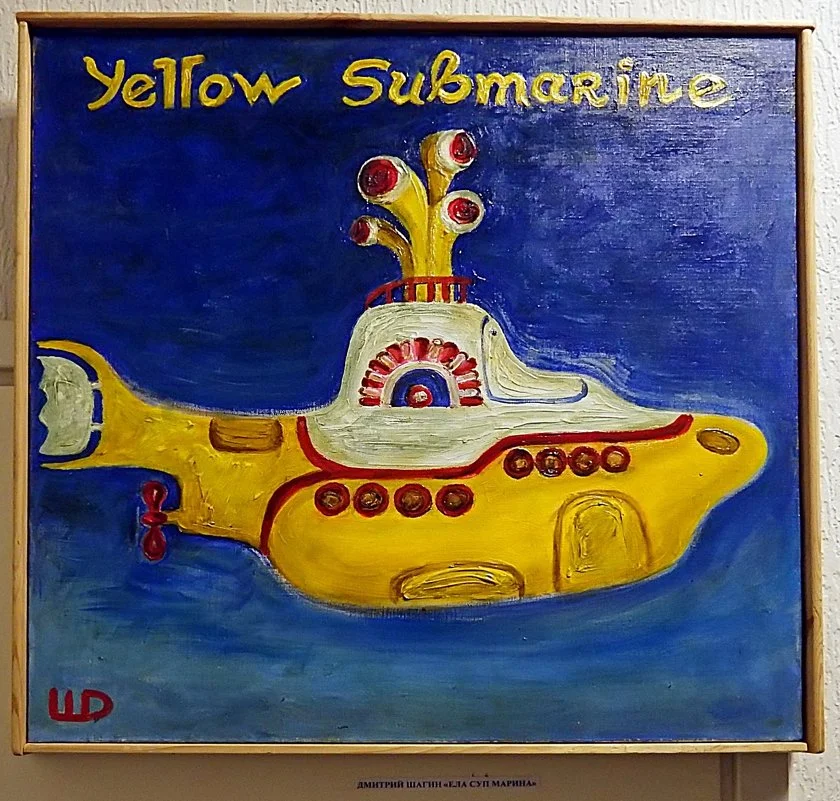
- Yellow Submarine — “Marina ate soup” (Yela Sup Marina) — Ела суп Марина (Marina is a female name). This one’s probably the second well-known, but there were so many variants that it felt like every family had its own. Submarine got rhymed with Somali, Margarine, and Pomorin (a Bulgarian toothpaste brand).
- Drive My Car — “Drink my kaif (transliteration + slang for a high/buzz)” — Дринк май кайф. A lesser-known distortion, but one mentioned by music critic and journalist Artemy Troitsky as well as the first one.
- What Goes On — “Here is the lawn” (Vot Gazon) — Вот газон. Variant: “Here’s the lawn—take it out!” (“вот газон — вынимай!”). It’s present in the memories of many Beatles fans and has been easily found on internet blogs since at least 2003 on the Beatles’ forums with reference to journalist Vladimir Ilyinsky, and in personal blogs.
- Ob-La-Di, Ob-La-Da — “Pay and own” (op-la-ti, ob-la-dai) — Оплати — обладай. Also less well known, but often found in blogs and forums for Beatles fans. Widely remembered; no period print cite found yet. Considering the song’s earlier appearance in 1968 and its popularity in the USSR (because of it’s simplicity), this is entirely possible.
Additional Misheardings From the USSR & Ukraine
- Any Time At All — “And don’t give me TNT” (Ee Ne Dai Mne Tol) — И не дай мне тол
- Hey Jude — “I walk” (Khah-zhoo) — Хожу
- Come Together — “Конь Тугеза” (Kon To-ge-za) — A horse by name Togeza (may be a modern intentional pun*
- Love Me Do — “Forehead stained in honey” (Lob v me-doo) — Лоб в меду
- It Won’t Be Long — “And now everything is white” (covered with snow) (Ee vot be-lo) — И вот, бело
- Ram On — “Repair process” (Re-mont) — Ремонт
- Let It Be — A bee is flying (Le-teet bee) — Летит би or in Russian-English version Летит bee
- Let It Be — “A beatle is flying” (Le-teet beetl) — Летит битл
- Little Child — “Alycha” (Ah-ly-chah) — Алыча or Cherry plum
- Baby’s In Black — “I’ll find vodka” (Vod-kee nai-doo) — Водки найду (after the lyric’s line “what can I do?“, and later after Smokie’s, “What Can I Do?). Widely remembered across russian fan communities.
- Yesterday — “Eat People” (Yesh L’udei) — Ешь людей (with some stretching — with a certain, unclear pronunciation) (some other mentioned Esti Dai — distorted “Let me Eat”)
Old Beatles fans and collectors Vadim Legkokonets and Andrei Lukanin documented these homophones from Soviet Russia and Ukraine in the 1960s and 1970s in their article. Despite Andrei and Vadim’s credibility, I believe “Kon To-ge-za” may be a modern-era homophone pun because I haven’t found any mention of it before 2006. That’s when the Russian band Bugotak made a parody cover of “Come Together” with the words “Kon To-ge-zyi” (an adjective describing the color or character of a horse). After that, their version became widely known on the internet.
They mention other intentional “paraphrases” of Beatles song titles:
- Lady Madonna— “Baba Matrona” — Баба Матрона (Matrona is a female name, often associated with the orthodox church)
- Day Tripper — “Daily Gonorrhea” (Dnevnoi Tripper) — Дневной Триппер
- She’s A Woman — “Vona zh moya baba” (direct translation to Ukrainian)
- Strawberry Fields Forever — Bulldozer (from the line in the song “nothing is real,” which sounds similar to the russian expression “na fig izryl” [Why did you dig that up?]).
As you can see, the range of errors was quite wide and varied across regions. Some of them have been known and confirmed for a long time, for example Kin’ Babe Lom is quoted even in The Times, and by cultural expert and member of the Kino group Alexander Lipnitsky in memoirs: “I remember Viktor [Tsoi] telling me how he and Pyotr showed up at a Beatles fan gathering and started singing …Kin’ Bab’e Lom… (Can’t Buy Me Love). The die-hard Beatlemaniacs were seriously offended. There was a crowd of hardcore fans at a Beatles anniversary, and Viktor told me the story, laughing.” (from Viktor Tsoi. Poems. Documents. Memories, A. Zhitinsky, Marianna Tsoi). Yela Sup Marina mondegreen is also known worldwide.
Lyric Parodies Based on Homophones
Artemy Troitsky noted that fans didn’t stop at titles—they jokingly “translated” lyrics, in part or in full:
“Soviet hippies inherited from the stilyagi a habit of not so much creating their own material as reworking name-brand Western originals to fit local tastes. Since the Beatles were much more visible than everyone else, people reworked them most actively. You Never Give me Your Money’ sounded like this:
Ty ne davala mine groshi
Ty ne davala mine teply boty
Tai vot teper’ ya dyozhe prostudilsya
Tai pomer. (roughly Ukrainian)
Back-translation: “You never gave me any money / you never gave me warm boots / and now I’ve caught a terrible cold / and died.”
This version of “You Never Give Me Your Money” is in the same rhythm as the original, but it uses Ukrainian stylization for comic effect. It’s likely that this and other funny “translations” came from accidentally coined homophonic titles or choruses—local memes.
For example, “Yela sup Marina” (“Marina ate soup”) became the subject of Dmitry Shagin’s paintings riffing on “Yellow Submarine” and one of his songs, although other Russian lyrics with the same refrain phrase exist—and we don’t know who wrote them (Incidentally, Joseph Brodsky translated YS into Russian around 1969 for the magazine “Kostyor”).
In the Russian adaptation, Yellow Submarine almost always turns into something like Bandersnatch—everyone translates it in their own way, and often only hints of the original text remain. It’s just natural folklore.
List of Non-Beatles USSR Homophones In The Late 70s & 80s
Although homophones and memes associated with the Beatles remained, new homophones from late 1970s pop and disco music gradually joined them:
- Шизгара — a distortion of “She’s got it,” from Shocking Blue’s “Venus” (the chorus).
Became a big Soviet and Russian meme and part of the music of Soviet rock bands. For example, the song “Secret Sign” by the band Chaif includes the lines “I’ll close the shutters, light all the candles. I’ll start up the Shizgaru and pass the evening”. Shizgara even had a website shizgara.su and used by official newspapers (wikipedia). - Варвара жарит кур — “Varvara roasts chicken” (Varvara zharit kur) — from Boney M., “Daddy Cool.”
Some recall the opening couplet morphing into: “They suddenly burned the village down; Varvara’s roasting chicken!” For the record, on a Melodiya pressing the very title “Daddy Cool” was translated as “Spokoynyy otets” (“Calm Father”). Known worldwide. - Водки найду — “I’ll find vodka” (Vodki naidu) — Smokie, “What Can I Do?”.
Very popular meme, partly because Melodiya released a licensed Smokie record with this song, and partly because there were also a parody lyric, and a russian translation by The Happy Guys band. Smokie manager John Wagstaff in 2012 refers to it: “Their number, What Can I Do, is especially popular,” he said. “I’ve even heard that Russian students turned it into a drinking song called Vodka I Do.” - Пили дрова — “Saw wood” (Pili drova) — Space, “Deliverance.”
Homophones Beyond Songs
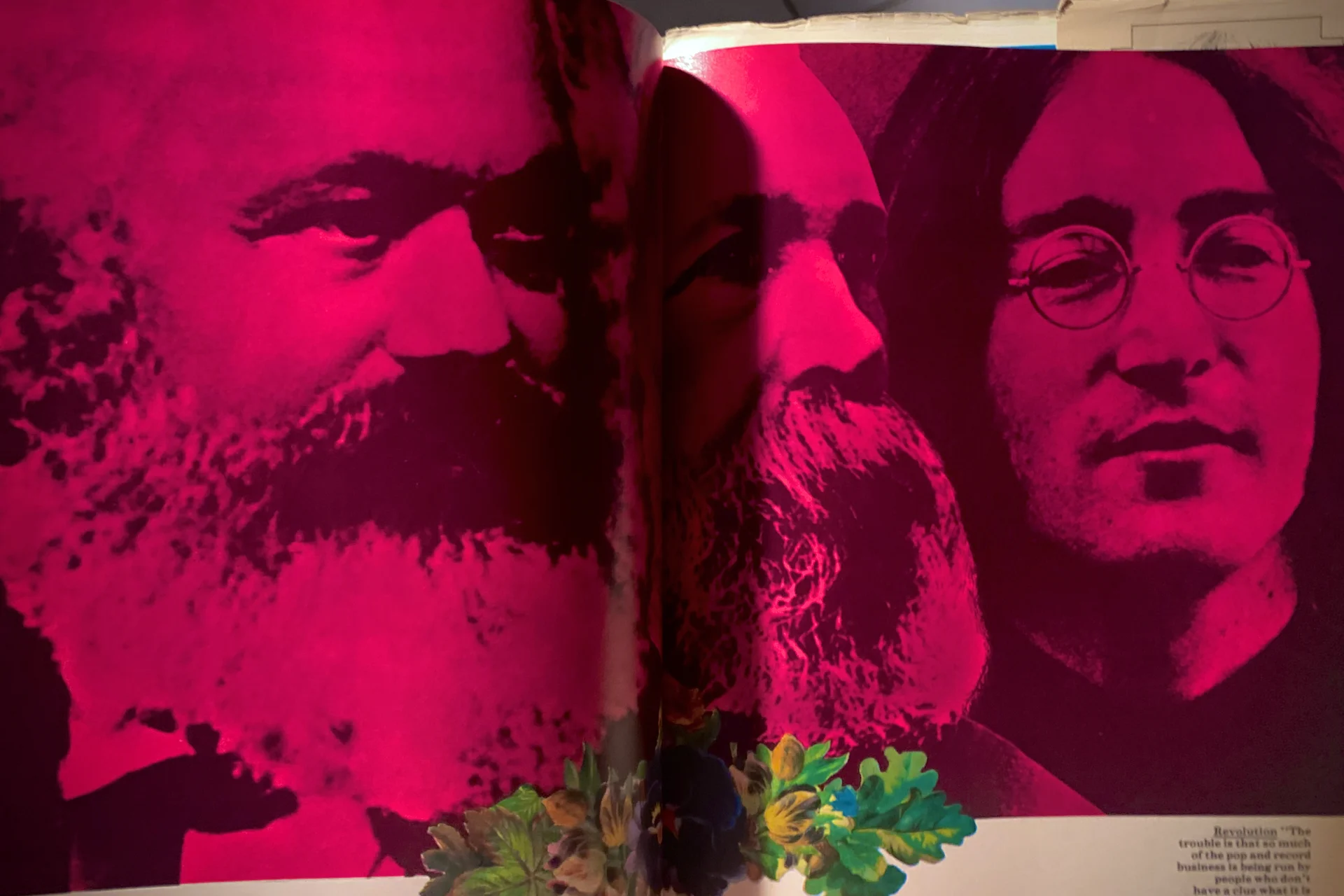
The “Soviet adaptation” even extended to album titles and musicians’ names. Fans called Lennon “Lenin” and McCartney “Makarenko.” It’s named after a famous Soviet educator and writer, as Artemy Troitsky recalls.
One user on the beatles.ru forum also mentioned:
“In ’67 people bragged that they had not only Revolver but also an avtomat (an automatic gun)—by which we meant the Rolling Stones’ Aftermath!”
This is a great example of homophony and the revolver/automat wordplay, and it also shows the rivalry between the Beatles and the Stones and the habit of comparing their recent albums.
Another Beatles fan remembered in 2006 how his friend got the nickname after the Uriah Heep:
One student runs up and shouts, “Guys, I found the record…I don’t know how to translate the band’s name, but these guys are definitely HIPPIES!” The student’s name was Yuri, and that’s how he earned his nickname that day.
The joke here is in the similarity between the name Yuri and Uriah, and the connection to the record (probably the Uriah Heep album) with Heep / Hippie rhyme.
Why & How Homophones Appeared in the Soviet Union
There are a few serious studies out there on homophonic translation in general, and I’d point to a recent German paper as a good example. It looks like knowing the source language can help you avoid mishearing, but having a more diverse vocabulary in your native language might actually lead to more creative reinterpretations.
It’s clear that similar effects happen in every country and language that comes into contact with another culture—it’s just how our brains work. In Germany, they call these cases the “Agathe Bauer” effect, after the way listeners heard the intro to Snap’s “The Power” (“I’ve got the power”) as “Agathe Bauer.” In the Netherlands, people started using the term “Mama Appelsap” (“mom, apple juice”) after Michael Jackson’s “Wanna Be Startin’ Somethin’,” where “Mama say mama sa mama koo sa” was heard a lot as “Mama appelsap.”
But the Iron Curtain, the distance between Russian and English languages, and internal censorship clearly shaped how homophones developed in the USSR. It’s not like regular misunderstandings or “false friends.” Soviet-English homophones are more like abstract, absurd and ironic local memes. But these memes made English-language songs by the Beatles, Shocking Blue, and others feel more relatable to Soviet listeners.
Beyond the obvious—like limited English proficiency and poor audio quality of early recordings—there are a few other factors that likely drove the rise of cross-language homophones and misinterpreted titles for foreign songs:
1. The humor and wordplay of musicians and early translators
Back in the 1960s, Western music wasn’t something everyone could easily access. People with good enough English—like linguistics students, sailors, poets, future diplomats—and a lot of music fans who studied in specialized English schools, could intentionally misinterpret familiar songs for laughs, creating early memes.
There’s a certain duality here. On the one hand, musicians, poets, and artists chose to distance themselves from politics and focus on creativity, giving themselves room to express themselves and play around with different forms, which was not really accepted in the Soviet Union (Alexei Yurchak writes about this, for example).
Despite that, they basically did the same thing as the official Melodiya label, adapting and censoring foreign songs to make them more Soviet and “their own.”
2. A semi-underground rock-culture
There wasn’t an outright ban on rock, but rock ‘n’ roll performances were sort of underground and people didn’t really like them. Also, there were no sanctions for amateur performances, unlike illegal concerts for money—and the amusing absurd titles seemed extremely unprofessional.
The Soviet government didn’t like Western music and lifestyle, so Soviet hippies, musicians, and fans of Western culture had to hide foreign influences as Soviet, change foreign titles, and make up their own language that the police and KGB couldn’t understand. By the 1980s, when there was more pressure on rock music, the people organizing illegal concerts came up with even more abstract codes for selling tickets.
3. Moving beyond just covers
They started out by performing English songs as close to the originals as possible. Then, Soviet musicians would translate and analyze the lyrics, and then adapt them—loading them with new meanings that made sense in the Soviet/Russian context—until they ultimately began writing songs in Russian that sounded just like the originals. This shift started in the early 1970s with the appearance of Aquarium, Mashina Vremeni (who also started with Beatles covers in the ’60s), Sankt-Peterburg, and later Zoopark—bands that built a bridge between the English tradition and the new Soviet rock.
This version is confirmed, for example, by Lithuanian magazine “Rock Partner” (No. 1, 1990, Robbie Maxwell) in an article about the birth of rock music in the USSR:
Until a certain point in time, the attitude toward language in rock music was clear: The Beatles sang in English, so all our bands diligently copied the brilliant originals. Occasionally, Russian-language songs appeared in some bands’ programs, but they were usually jokes or parodies.
The first step was to exploit the phonetic similarities between English and Russian phrases or words. Sometimes, the so-called “fish,” a meaningless phrase that mimicked the rhythmic structure of the English verse, was used as the “key” phrase of the Russian-language version. Given that the vast majority of listeners and performers had only a vague understanding of English, this practice was understandable and perhaps inevitable, although it obviously had no future.

Unlike with bootleg cover adaptations, where artists re-created the original artwork but added Soviet elements on purpose, it seems that homophones, name distortions, and playful “translations” of songs probably first came about among linguistics students, musicians, and artists. These were people who didn’t always understand the original lyrics or couldn’t make them out because of bad recording quality. But sometimes they naively and intuitively combined foreign song titles and musicians’ names with Soviet references and terms, choosing words that simply sounded good.
A lot of musicians wrote songs in a similar way. For example, Brian Eno often sang nonsense over a new melody until finished lyrics appeared, and sometimes that nonsense stayed in the final version because it sounded better. Eno remarked on a 1980 interview on Berkeley’s KPFA-FM:
“It works from sounds to words and from words to meaning… quite the other way around from the way people normally think lyrics are written,”
4. Accidental domestication by listeners — meme development by musicians
For a lot of people, these homophonic “translations” were just a way to make English songs more relatable to native Russian and Soviet listeners. They weren’t really planned, they just happened. Since they didn’t speak enough English, fans sang the words they thought they heard (In fact, The Beatles and other Western bands encouraged people to learn English) Even after they learned a song’s real meaning, their version often stuck as a meme and kept spreading. Song titles were often shortened to a convenient form.
As audio players got better in 70s and foreign rock albums became more available in the USSR, mishearing variants multiplied, and some adaptations turned intentionally ironic and funny.
Memes that started out as accidents turned into full-on translation adaptations. Just like Grebenshchikov & Aquarium borrowed direct quotes from Bowie and Dylan when writing Russian lyrics, Shagin pieced together his own “Yela-Soup-Marina” using Mitki memes and lore.
It’s possible that what started as accidental homophones turned into intentional homophonic-like translations and eventually became the lyrics of Soviet rock songs, filled with references to their English sources.
Sources
Western media / context
- The Guardian: Bone music – Soviet bootleg records pressed on X-rays
- The Times: Ben Macintyre on misunderstandings caused by mishearing
- The World: The spread of mondegreens
- The Guardian: The Beatles in Russia (2003)
- The Guardian: Smokie’s secret Kremlin gig
- AV Club: Misheard translated lyrics are a global phenomenon
Academic / analytical
- Alexei Yurchak — Everything Was Forever, Until It Was No More (Princeton University Press)
- PMC article: mishearing / linguistics / psychology
- Article by Andrey Lukanin and Vadim Legkokonets
Primary Soviet/Russian fan culture
- Diversant Daily archive (2005) (Artemy Troitsky)
- Beatles.ru forum thread 1
- Beatles.ru forum thread 2
- Beatles.ru forum thread 3
- LiveJournal blog post
- Gazeta.ru archive (2006)
- Ex-Pressa samizdat: Rokpartner
- Kulemzin Poetry website
Special cases / curiosities
This article is also available at archive.org at the CC Attribution 4.0 International license and on Zenodo: https://zenodo.org/records/17164121
If you have any other examples of homophones or homophonic translations in the context of English-language rock music in the USSR, please leave a comment here or email them to [email protected].
Leave a Reply
You must be logged in to post a comment.