
Rovesnik was a Soviet youth magazine for readers aged 14 to 28. It was launched in July 1962 and published until 2014. During its heyday, it was printed in the millions, making it one of the most widely circulated publications for young people in the USSR.
Table of Content
- Design & Themes
- 1960s Friendship
- 1970s: Yellow Submarine, Dylan, Lennon
- Mid-70s: A Filtered Window
- 1976: Morrison, Led Zeppelin
- 1977: Starr, Harrison, Lennon
- 1978: Sex Pistols, Blackmore, Harrison
- 1980s
- 1981: The Wall, Police, Clash, Parsons
- The Beatles’ Biography by Hunter Davies
- Rock and the Culture Wars
- The First Rock Encyclopedia in the USSR
Its official mission was clear: Rovesnik was to highlight the struggles of capitalist youth and celebrate the triumphs of socialist societies. It covered international student delegations, liberation movements in the Global South, and the “tormented lives” of American teenagers under capitalism. But over time, the magazine changed a lot and became a way for Western culture to share its ideas in a subtle and sometimes subversive way.
“It was a window to the world,” says former editor Natalia Rudnitskaya. “Naturally, a window with layers of filters. But it still helped those who really wanted the info find it. We got things in by disguising them as criticism. There weren’t many other sources. There was the weekly Za Rubezhom and Inostrannaya Literatura, but they were serious publications. Rovesnik was a bit of a loose cannon, and that made all the difference.”
Design & Themes
In the beginning, Rovesnik really stood out because of its neat layout and playful use of fonts. Since there weren’t a lot of technical resources, collage was the magazine’s main visual technique. It gave the pages a distinct, handcrafted feel, sometimes even with infographics!
It’s one of the best examples of Soviet typography:

1960s Friendship
Up until 1969, the magazine was mostly about international friendship. The USSR was shown as being on good terms with countries like Algeria, Chile, Peru, and Cuba. These countries were shown as having problems with high unemployment and food shortages, but moving toward socialism.
Meanwhile, the magazine regularly reported on unrest in the West — student protests, labor strikes, and growing dissatisfaction across America and Europe in every issue.
Around 1968–69, the tone of the editorials started changing. Almost every article seemed to warn of dangers lurking outside the Soviet borders: Venice was sinking, America was plagued by theft, Germany was accused of forced labor, and Italian children were allegedly trapped in exploitative work. Color TVs in the US were called “one-eyed monsters.”
1970s: Yellow Submarine, Dylan, Lennon
By 1970, paranoia had set in. The magazine focused a lot on military themes and the USSR in the context of World War II.
Headlines were full of words like war, conspiracy, prison, spy, executioner, monster, bombs, sinister shadows, and dispatches from a sick world.
But a few rare stories about global pop culture made it through in the early ’70s. There were articles on Yellow Submarine, John Lennon’s Live in New York concert, and short mentions of the Rolling Stones, Neil Diamond, and Bob Dylan.
Mid-70s: A Filtered Window
By the mid-1970s, the magazine’s look had pretty much disappeared. The layouts used to be dynamic, but now they’re just a bunch of text with maybe one or two illustrations. But when it came to content, there was a change happening — culture was making a slow comeback.
The authors at Rovesnik became pros at getting around Soviet censorship. For years, they’d sift through international magazines — which were carefully checked by Glavlit, the state censorship agency — to find content on music, film, literature, and youth culture from other countries.
“We had a closed subscription,” Rudnitskaya remembers. “We got international magazines that were delivered by courier from Glavlit in sealed bags. Even The Atlantic was there, but practically every page had to be ripped out.”
Every week, we got bags of foreign magazines. They were kept in safes and issued like library books — cataloged, censored, and sometimes literally carved up. Magazines had hexagonal censor marks on them, and notes on the covers said which pages were taken out — usually anything about life in the USSR.
“We reviewed them every day,” she says. “We jotted down anything we could use.
Every year, the authors of Rovesnik wrote letters to the Foreign Literature Library. To get Playboy with good articles, they had to say in their letters what topics they were interested in.
Becoming a contributor was surprisingly easy — as long as you could write. Young authors submitted articles, reviews, and translations. If the text was strong enough, it made it to print.
1976: Morrison, Led Zeppelin
Even though he was always being watched, Rovesnik became known for testing the limits. Writers and editors shared some real insights about Western life, but they did it by criticizing it. In April 1976, there were two rock articles in the same issue—one about Jim Morrison and the other about Led Zeppelin.
“Publishing something about The Doors in 1976 — that was a victory,” Rudnitskaya says. “It was a great text. I found it somewhere, but I can’t remember where. I was blown away by the writing and the essence. I just sat down and translated it because I had to.”
1977: Starr, Harrison, Lennon
A year later, in 1977, the magazine featured translated interviews with Ringo Starr (called “humble”), George Harrison about 33 & 1/3, and John Lennon about Rock’n’Roll album.
1978: Sex Pistols, Blackmore, Harrison
In 1978, Rovesnik did an interview with the Sex Pistols; in 1979, he did another with B.B. King, Ritchie Blackmore, and George Harrison.
1980s
By the early 1980s, the focus of editorials had shifted back to war. While writing this piece, I got pretty tired of all the repetitive propaganda — the constant glorification of World War II and making military heroism seem like some kind of mythical thing. But really, that’s just how things were back then. If you look at how Krugozor or Student Meridian changed over time, you’ll see the same patterns.
1981: The Wall, Police, Clash, Parsons
Even so, the magazine still included some notable music features, like articles on The Wall in late 1981 and on The Clash and The Police in 1982.
Later, Alan Parsons was added to the club:
The Beatles’ Biography by Hunter Davies
Temporary ban of rock & soviet caricatures
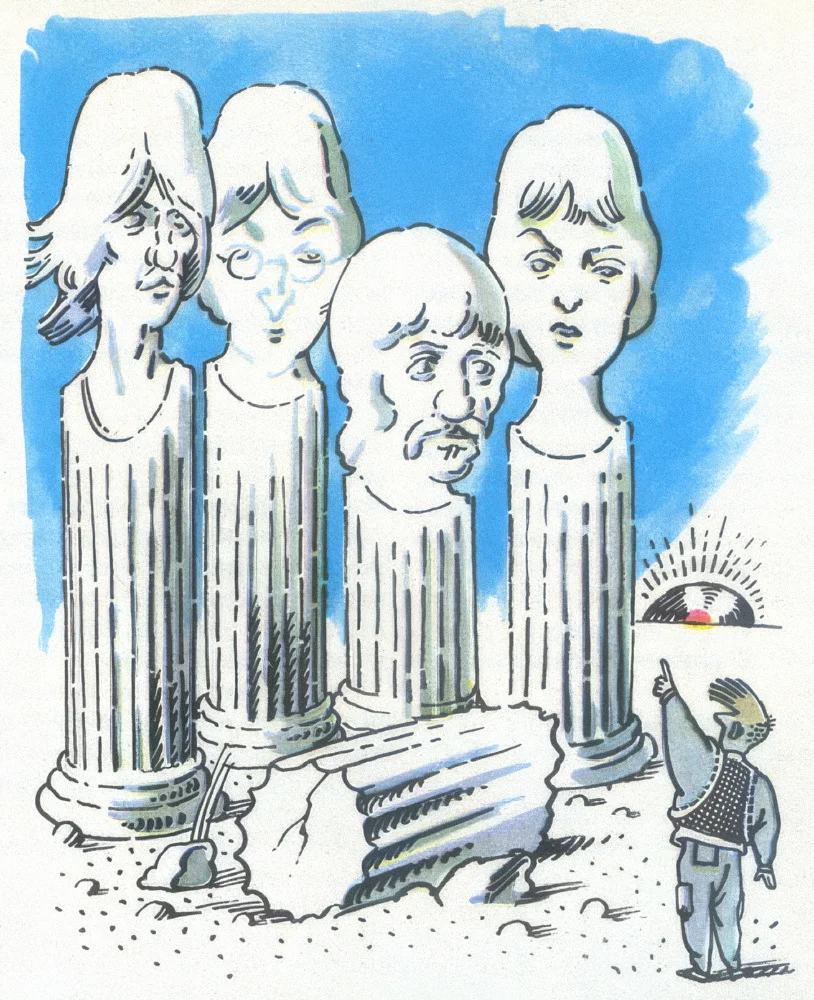
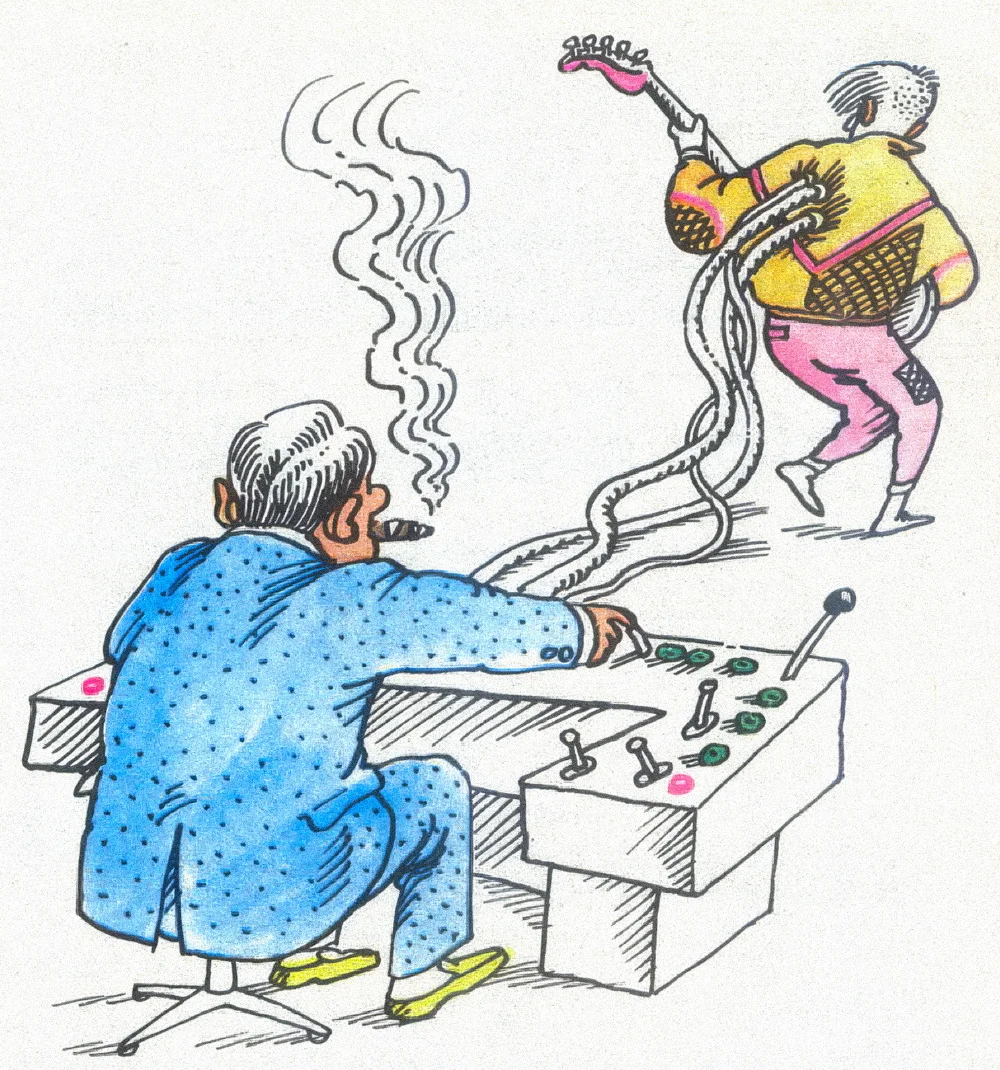
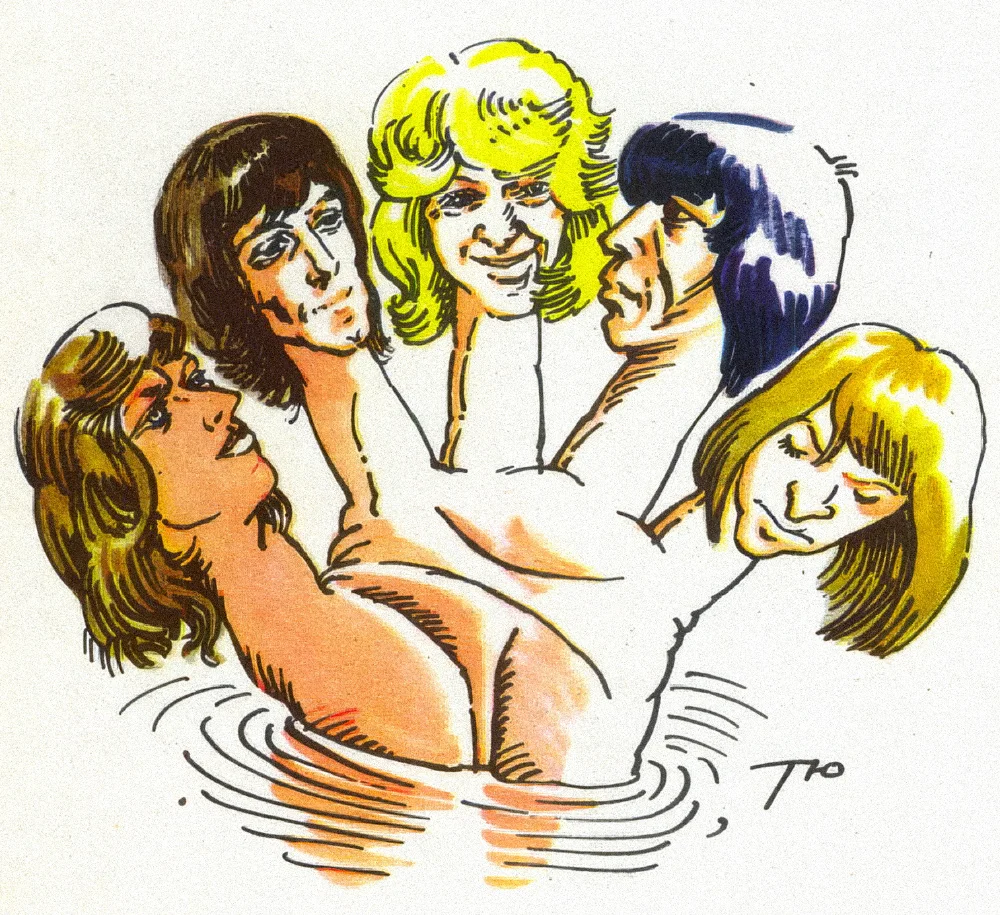
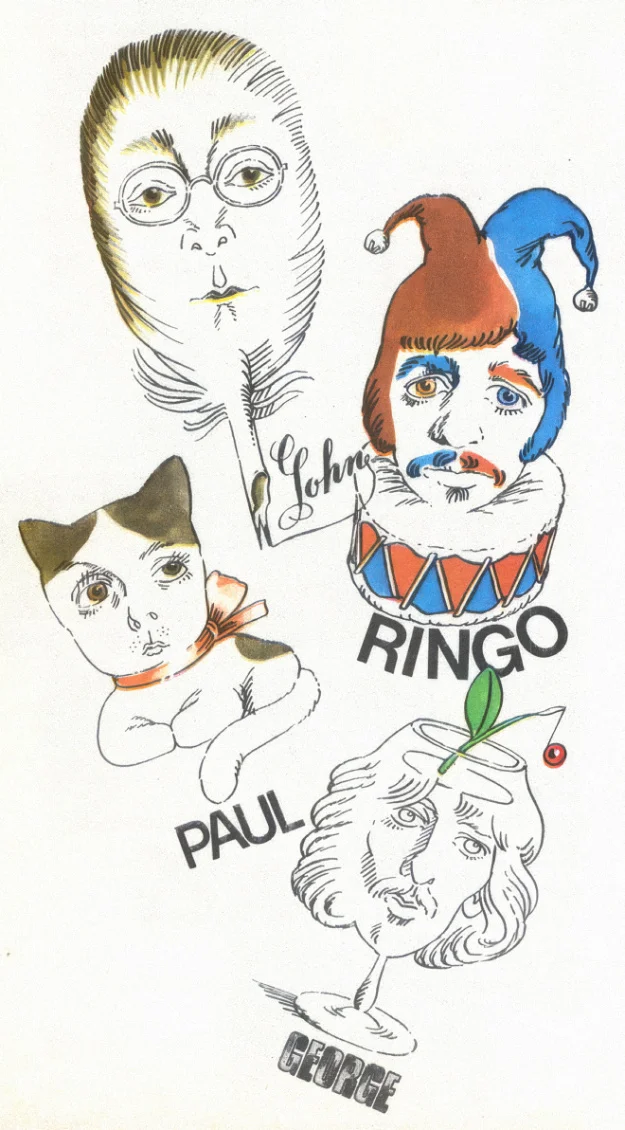
From 1983 to 1985, the Soviet Union started banning rock music again. This was also reflected in Rovestnik: the number of interviews with foreign musicians decreased, and the few articles that were published were often accompanied by rather repulsive caricatures instead of photos.

Late 1980s: Zappa, U2, Dire Straits
With the start of perestroika, there was more material about popular music: Frank Zappa, U2, Kraftwerk, Philip Glass, Dire Straits, Manfred Mann’s Earth Band.
Rock and the Culture Wars
The magazine’s editors often got a lot of flak from more conservative publications. Igor Chernyshev, who became editor-in-chief in 1988, remembers the public feuds with magazines like Molodaya Gvardiya, which denounced rock music as moral decay.
“They called rock ‘a spawn of hell’ — said it dumbed people down,” Chernyshov remembers. “So we replied, point by point — and we had a lot of points — and showed they had no idea what they were talking about. Rock music was only played at Easter, when they tried to distract people from church. There was a program called “Melodies and Rhythms of Foreign Pop Music,” which featured ABBA or someone else, or “International Panorama” showed a snippet of a performance by some band.
Even so, Rovesnik was operating within the law. It paid small fees for reprinted material through the Soviet copyright agency, which later became the Russian Authors’ Society.
“We once reprinted something from Paris Match and paid 27 francs — which wasn’t nothing back then. A little later, we got a call from France. Someone asked, “Excuse me, what comma did you just pay me 27 francs for?”
The First Rock Encyclopedia in the USSR
By the mid-80s, Rovesnik had basically become the go-to guy for rock music in the Soviet Union. Journalist Sergey Kastalsky started a long-running series called Rock Encyclopedia, where he gives super detailed reviews of albums by Western artists. It was a revolutionary project — the first rock encyclopedia.
“We had an unspoken monopoly on rock coverage,” says Chernyshov. “No one else was allowed to write about it at that level.”
The magazine’s circulation hit its peak in the early ’90s, with three million copies being read each month. The distribution was a bit of a mess, but we managed to get things done. With kiosks popping up all over the place and no proper distribution channels, Chernyshov decided to take things into his own hands.
“I had this old Zhiguli car. I’d load it up — trunk, backseat, front seat — full of magazine bundles and deliver them myself around Moscow and the suburbs.”
In 2014, Rovesnik had to close because it didn’t have enough funding.
Leave a Reply
You must be logged in to post a comment.